CupertinoNavigationBar
An iOS-styled bottom navigation tab bar.
Navigation bars offer a persistent and convenient way to switch between primary destinations in an app.
Inherits: LayoutControl
Properties
active_color- The foreground color of the icon and title of the selected destinations.bgcolor- The color of the navigation bar itself.border- Defines the border of this navigation bar.destinations- The destinations of this navigation bar.icon_size- The size of all destination icons.inactive_color- The foreground color of the icon and title of the unselected destinations.selected_index- The index into destinations for the currently selected NavigationBarDestination.
Events
on_change- Called when selected destination changed.
Examples
Basic Example
import flet as ft


def main(page: ft.Page):
    page.title = "CupertinoNavigationBar Example"

    page.navigation_bar = ft.CupertinoNavigationBar(
        bgcolor=ft.Colors.AMBER_100,
        inactive_color=ft.Colors.GREY,
        active_color=ft.Colors.BLACK,
        on_change=lambda e: print("Selected tab:", e.control.selected_index),
        destinations=[
            ft.NavigationBarDestination(
                icon=ft.Icons.EXPLORE_OUTLINED,
                selected_icon=ft.Icons.EXPLORE,
                label="Explore",
            ),
            ft.NavigationBarDestination(
                icon=ft.Icons.COMMUTE_OUTLINED,
                selected_icon=ft.Icons.COMMUTE,
                label="Commute",
            ),
            ft.NavigationBarDestination(
                icon=ft.Icons.BOOKMARK_BORDER,
                selected_icon=ft.Icons.BOOKMARK,
                label="Favorites",
            ),
        ],
    )

    page.add(
        ft.SafeArea(
            content=ft.Text("Body!"),
        )
    )


if __name__ == "__main__":
    ft.run(main)
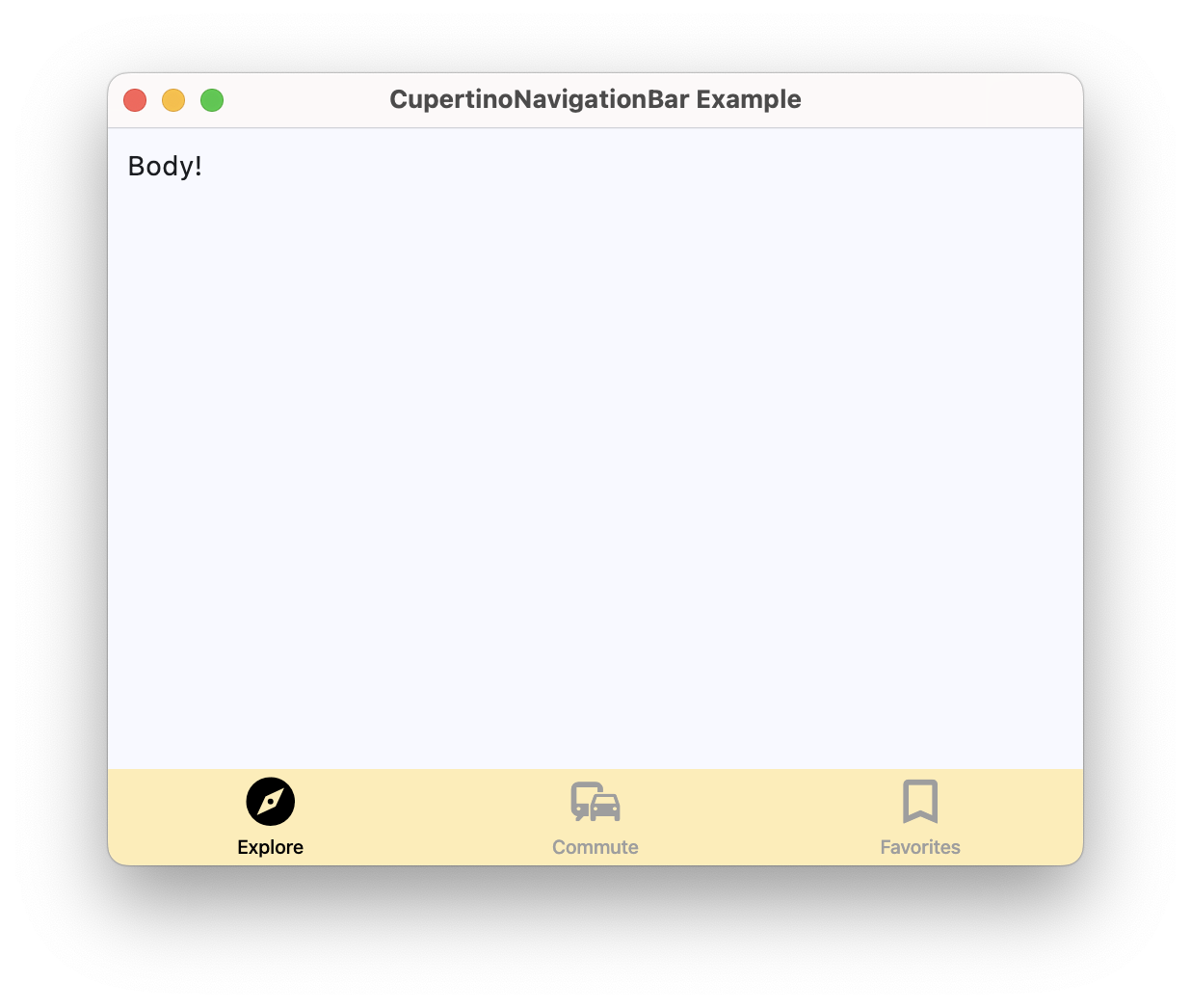
Wired navigation bar
import flet as ft


def main(page: ft.Page):
    page.title = "CupertinoNavigationBar Example"

    body_text = ft.Text("Explore!")

    def handle_nav_destination_change(e: ft.Event[ft.CupertinoNavigationBar]):
        if e.control.selected_index == 0:
            body_text.value = "Explore!"
        elif e.control.selected_index == 1:
            body_text.value = "Find Your Way!"
        else:
            body_text.value = "Your Favorites!"

    page.navigation_bar = ft.CupertinoNavigationBar(
        bgcolor=ft.Colors.AMBER_100,
        inactive_color=ft.Colors.GREY,
        active_color=ft.Colors.BLACK,
        on_change=handle_nav_destination_change,
        destinations=[
            ft.NavigationBarDestination(
                icon=ft.Icons.EXPLORE_OUTLINED,
                selected_icon=ft.Icons.EXPLORE,
                label="Explore",
            ),
            ft.NavigationBarDestination(
                icon=ft.Icons.COMMUTE_OUTLINED,
                selected_icon=ft.Icons.COMMUTE,
                label="Commute",
            ),
            ft.NavigationBarDestination(
                icon=ft.Icons.BOOKMARK_BORDER,
                selected_icon=ft.Icons.BOOKMARK,
                label="Favorites",
            ),
        ],
    )

    page.add(
        ft.SafeArea(
            content=body_text,
        )
    )


if __name__ == "__main__":
    ft.run(main)
Properties
active_colorclass-attributeinstance-attribute
active_color: Optional[ColorValue] = NoneThe foreground color of the icon and title of the selected destinations.
bgcolorclass-attributeinstance-attribute
bgcolor: Optional[ColorValue] = NoneThe color of the navigation bar itself.
borderclass-attributeinstance-attribute
border: Optional[Border] = NoneDefines the border of this navigation bar.
destinationsinstance-attribute
destinations: Annotated[list[NavigationBarDestination], V.visible_controls(min_count=2)]The destinations of this navigation bar.
Raises:
- ValueError - If it does not contain at least two visible
NavigationBarDestinations.
inactive_colorclass-attributeinstance-attribute
inactive_color: ColorValue = CupertinoColors.INACTIVE_GRAYThe foreground color of the icon and title of the unselected destinations.
selected_indexclass-attributeinstance-attribute
selected_index: int = 0The index into destinations for the currently selected NavigationBarDestination.
Raises:
- IndexError - If it is not greater than or equal to
0. - IndexError - If it is not less than the length of visible destinations.
Events
on_changeclass-attributeinstance-attribute
on_change: Optional[ControlEventHandler[CupertinoNavigationBar]] = NoneCalled when selected destination changed.